
Boyd Juvenile Release Boundaries
Boyd Regional Juvenile Detention Center is a secure regional facility operated by the Kentucky Department of Juvenile Justice. Its population is not part of the adult Boyd County jail roster. It is also outside KOOL, the adult Kentucky corrections lookup, for public release-search purposes. The BOP locator covers federal inmates, not youth held by Kentucky DJJ.
Kentucky juvenile court and agency records are generally confidential under KRS 610.340, subject to the access routes written into law. That boundary protects a youth’s name, allegations, custody status, placement, and release details. A missing public result is expected. It does not establish that the youth was never held, has been released, or is now at a particular place.
Authorized Boyd Youth Release Checks
The lawful route depends on the requester’s role and the court matter. A parent or guardian should use contact instructions already supplied by DJJ or the child’s case team. An attorney should proceed through counsel access and the juvenile court record. A person without legal authority should not seek identifying details through staff, public-record requests, or adult lookup tools.
- Identify the DJJ worker, attorney, or juvenile court connected to the case.
- State the requester’s relationship and be ready to verify identity and authority.
- Ask which protected record or notice can lawfully be shared.
- Follow the court or DJJ instructions for receiving information securely.
- Do not post, relay, or republish information beyond the permitted purpose.
The institution may confirm general public information about operations, but it should not be expected to confirm that a named youth is present. Release planning can involve family, a court, DJJ, counsel, and a placement provider. Those participants receive information through controlled channels.
Boyd Juvenile Placement Outcomes
Leaving this building does not have one public meaning. A youth may return to an authorized caregiver under court conditions, enter a treatment or community placement, transfer within the juvenile system, or appear for another court-directed step. A transfer remains a placement change. It should not be described as an unrestricted return home.
| Possible event | Correct interpretation |
|---|---|
| Return to caregiver | A court or DJJ-authorized community placement, possibly with conditions |
| Program placement | Continued juvenile-system involvement at a different setting |
| Facility transfer | Custody or placement continues elsewhere |
| Court appearance | A proceeding, not proof that detention ended |
| No public result | An expected effect of confidentiality, not a release finding |
An authorized case contact can explain which event occurred and what instructions apply. Public adult terminology such as parole, adult probation, sentence expiration, and BOP supervised release should not be pasted onto a juvenile matter.
Boyd Juvenile Records Access
Juvenile records do not become ordinary adult public records because someone asks for a “release sheet.” The applicable court and DJJ rules determine access. An authorized request should be narrow and should identify the specific case connection, the requested record, and the legal or case role supporting access. Staff may require proof of identity or direct the requester to the court.
The juvenile court is the source for protected orders in the case. DJJ is the source for agency placement information that it may lawfully disclose. The Boyd County Detention Center records custodian handles adult county-jail records and cannot certify a youth’s release from this DJJ facility. CourtNet’s public adult case access also cannot be treated as a substitute for a confidential juvenile file.
- Juvenile detention
- Secure temporary custody for a young person within the juvenile justice system.
- Placement
- The setting authorized for care, custody, treatment, or supervision.
- Authorized party
- A person whose legal or case role permits access to specified protected information.
- Confidential record
- A record withheld from general public view and available only through lawful routes.
Boyd Juvenile Facility Contact
The official DJJ facility page confirms the center’s identity, agency, address, contact number, capacity, and history. It does not create a public youth locator. Calls involving a named youth should come from an authorized person prepared to follow the facility’s identity and access procedures.
2420 Roberts Drive
Ashland, KY 41101
606-920-2085
Kentucky Department of Juvenile Justice
The official page describes a 39-bed secure regional juvenile detention center that opened in 2004. Those facts explain the facility’s public role without identifying any youth.
The image below documents the official facility page and must not be read as a public roster.
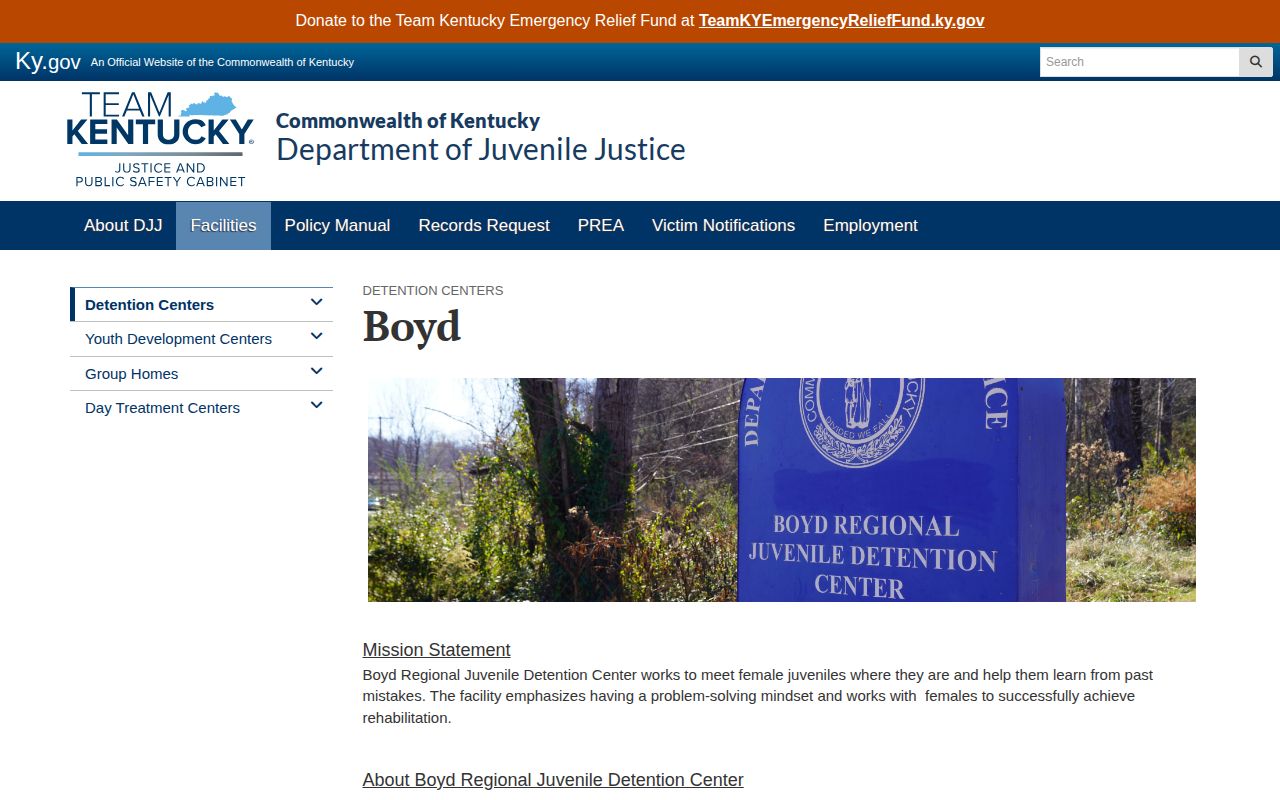
Its value is facility identification. It provides no lawful basis to seek or disclose a child’s status.
No Boyd Youth Release Feed
No official public youth roster, 24-hour release list, 72-hour release list, or historical release feed was found for the Boyd juvenile center. That absence reflects the different legal treatment of juvenile information. It must not be filled with names from social posts, unofficial lists, adult jail results, or secondhand reports.
Kentucky VINE serves victim-notification functions for covered jail and corrections records, but the research does not establish it as a public youth-release index for this facility. KOOL publishes adult correctional information. The Boyd Cadmus portal is a current-inmate service for the adult county detention center. BOP serves federal custody. None is an alternate door into the juvenile record.
The Boyd County released-inmate search explains adult county, state, and federal channels. Its adult search paths should stop when the matter is identified as juvenile. At that point, an authorized DJJ or court contact is the only proper route.
Boyd Juvenile Court Confirmation
A court order can govern release, custody, treatment, or placement, but juvenile confidentiality limits who may obtain or discuss it. The date of an order may also differ from the time staff complete a move. An authorized party should ask the case contact which instruction is current rather than infer status from a hearing date.
If counsel needs the signed order, counsel should use the juvenile court’s established access process. Parents and guardians should rely on the directions given for their case and advise staff when contact information changes. Other relatives or friends may care deeply yet still lack authority to receive protected information. Staff refusal to discuss a named youth is not proof of presence or absence.
Sealed and confidential records must remain respected. Adult expungement procedures and adult public dockets do not authorize reconstruction of a juvenile history. The sound record practice is restraint: verify through the case channel, disclose only what is permitted, and avoid retaining or redistributing details that were supplied for a limited purpose.
After a Boyd Youth Release
Release planning is case-specific. A youth may have court terms, treatment, education, family, or community-program requirements. Public adult supervision labels cannot reliably describe those duties. The assigned DJJ worker, attorney, or court order is the source for instructions supplied to the youth and authorized caregiver.
Transportation and pickup details are also protected operational matters. No official research source provides a routine release hour, public waiting point, or standard exit procedure. An authorized caregiver should confirm the time, identity documents, pickup location, and approved adult directly through the case contact. No one should travel based on a guessed date or an unofficial message.
If a later adult custody record exists, it must be evaluated on its own official source and cannot be used to expose an earlier juvenile file. Boyd Regional Juvenile Detention Center is listed with local facilities so readers can distinguish it from the adult jail, not so youth records can be folded into an adult released-inmates database.
An authorized caregiver should keep case instructions within the circle identified by DJJ or the court. School arrangements, treatment appointments, residence terms, and transportation can reveal protected placement facts even when a youth’s name is omitted. Public confirmation is not the goal. The responsible adult needs the current direction from the official case source and a way to resolve any conflict with an older notice.
Requests from news, neighbors, extended family, or online groups do not become authorized because detention is rumored. Facility and court staff may decline to confirm the premise. That response protects the juvenile process and is not evidence that the youth is inside, has transferred, or has gone home. The same restraint applies to photographs, hearing dates, and alleged offenses tied to the confidential matter.
When an authorized party receives a new order or placement notice, compare its case number, issuing office, and date with prior instructions. Questions about meaning belong with counsel, the assigned worker, or juvenile court. The adult Boyd jail, Kentucky adult corrections, and federal prison staff cannot interpret a DJJ placement or certify completion of a juvenile case. Each system stays within its own legal authority.