
FCI Ashland Release Routes
Federal Correctional Institution Ashland is a Bureau of Prisons institution in Boyd County. Leaving its grounds can mean several things. A person may transfer to another BOP prison, travel under federal authority, enter a residential reentry center, move to home confinement, or leave BOP custody at the end of the federal term. Only the last event is a final BOP release. A building departure alone cannot establish it.
The BOP Inmate Locator supplies the key public fields: Location and Release Date. Read them together. A past date with no institution location supports that the person left BOP custody on the stated date. A result labeled “Released” or “Not in BOP Custody” carries the same basic meaning. It does not show that all court control ended. Supervised release may follow, and another authority could hold the person.
Confirm an FCI Ashland Release
Start with the BOP Inmate Locator. It covers federal inmates released from 1982 to the present. A number search is strongest because it separates people with similar names, though the locator also accepts a name with optional age, race, and sex fields.
- Search by BOP register, DCDC, FBI, or INS number when one is known.
- Otherwise enter the first, middle, and last name, then use the optional identifying fields.
- Match the register number and biographical details before reading the custody result.
- Compare Location with Release Date; do not treat either field alone as conclusive.
- Use the sentencing court docket or U.S. Probation office for supervision after BOP custody.
A future release date is projected and may change. “Unknown” means the confinement term is not determined. “In Transit” often reflects movement involving the U.S. Marshals Service and does not establish release. The Boyd County released-inmate search also separates federal records from county and Kentucky systems.
FCI Ashland Locator Fields
The locator is a custody index, not a full criminal docket. Each result field has a limited job, and the BOP’s own definitions control its meaning.
| Field or label | What it establishes |
|---|---|
| Register number | The federal identity used to match the correct record |
| Location | The reported BOP institution or community-corrections assignment |
| Future release date | A projected date that can change |
| Past date, no facility | Departure from BOP custody on the shown date |
| In Transit | Movement, not proof of community release |
| Released | No longer in BOP custody, without deciding later supervision or other custody |
The result also shows name, current age, race, and sex. Those fields help prevent a false match. They do not state the terms of supervised release, resolve a federal charge, or identify every later custodial agency.
FCI Ashland Federal Records
A historical release record begins with the locator result, but the federal docket provides the legal frame. The judgment states the custodial sentence and any supervised-release term. Later orders can change the sentence or release conditions. PACER or the clerk of the sentencing court is therefore the right route when the legal basis matters. The appropriate U.S. Probation office addresses federal supervision after release.
Neither the Boyd County Detention Center nor the Boyd Circuit Court Clerk keeps the controlling FCI Ashland release record. KOOL is the Kentucky Department of Corrections system and does not certify a federal departure. Kentucky VINE may cover county or state records, but it is not the BOP locator. Keeping these custodians separate prevents a blank state search from becoming a false claim about federal status.
- Supervised release
- Court-ordered federal monitoring after imprisonment; it is distinct from Kentucky parole.
- Transfer
- A change of custodial location while federal custody continues.
- Residential reentry center
- A community-based federal placement, often called an RRC or halfway house, within the BOP structure.
- Detainer
- A notice that another authority may seek custody; it can affect where a person goes next.
FCI Ashland Contact Record
The official FCI Ashland facility page identifies both the institution and its associated satellite camp. Use the locator for public custody status. Call the institution for an appropriate operational question, not as a substitute for checking the federal record.
State Route 716
Ashland, KY 41105
606-928-6414
Agency: Federal Bureau of Prisons
A focused request should provide the full name and register number, if known, and identify the existing record sought. Ask for a release or movement record, not a broad explanation. Some material may be restricted by federal privacy, safety, or institutional rules. The public locator remains the first released-status source.
The official facility image below shows the shared BOP page for the main institution and camp.
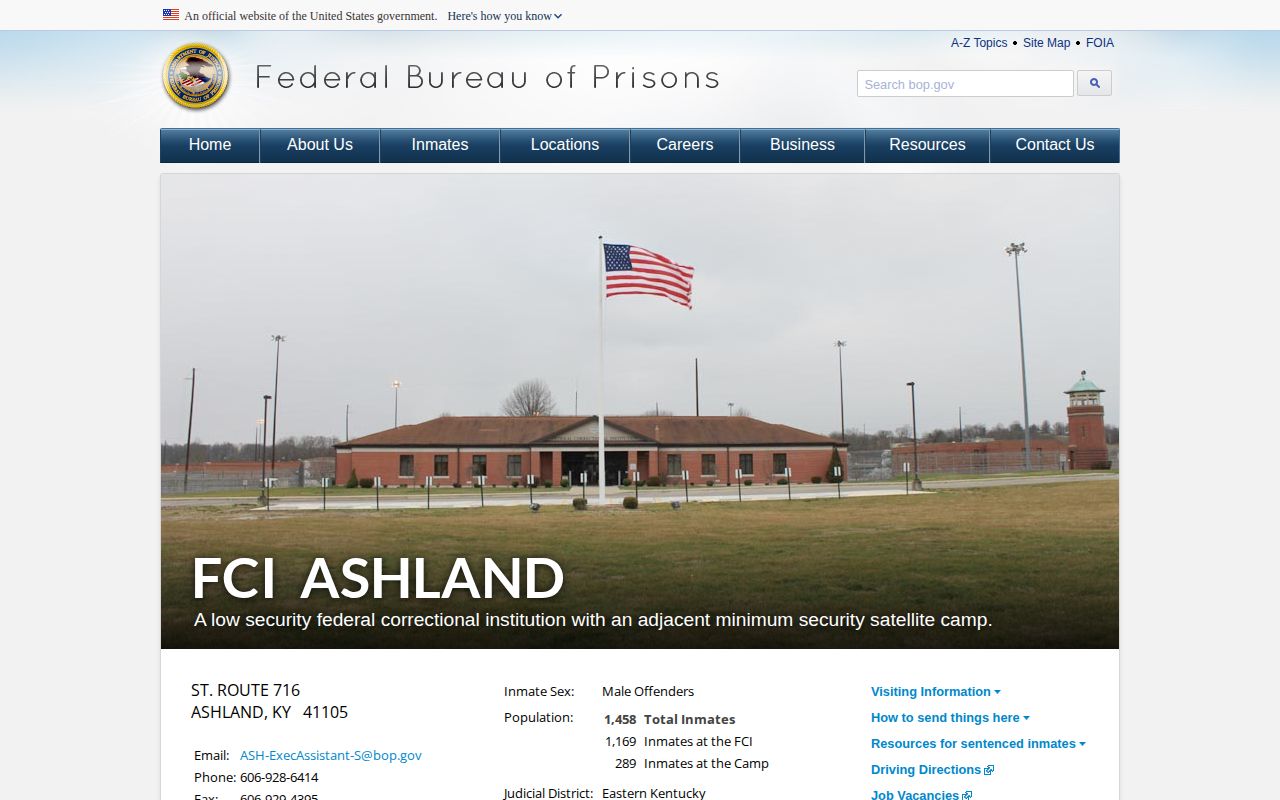
That source confirms the facilities’ federal identity, which is why Boyd County and KY DOC searches cannot replace the BOP route.
FCI Ashland Transfer Checks
A current location at another federal institution means the person moved within BOP custody. A Community Corrections Management entry may point to an RRC arrangement. Home confinement also places a person outside a prison cell without ending the federal custody structure. None should be restated as unconditional release.
If “In Transit” appears, allow for federal movement and check again. The U.S. Marshals Service commonly handles federal pretrial custody and transport, but it does not publish a historical release locator equal to BOP’s. The federal docket may show a court-ordered release in a pretrial matter. For a person later designated to BOP, the BOP record becomes the main location source.
An ICE pickup or another agency hold is also a transfer of control, not a community return. ICE’s locator has its own scope and does not search minors. No research source says FCI Ashland is an ICE facility. Follow the named receiving authority rather than assuming all federal systems share one record.
FCI Ashland Release Date Limits
The date displayed before release is an estimate. Sentence computation, court action, earned credit, disciplinary changes, or another valid federal event can alter it. A projected date should never be promised as a pickup time. The BOP does not publish a routine exit hour for FCI Ashland in the Boyd research.
After the date passes, inspect the current location again. A past date paired with no institution is stronger evidence than an old screenshot of a projection. Save the register number and the date checked when accurate timing matters. If a court order and locator seem inconsistent, the BOP record answers federal custody while the court record answers legal authority. Both may be accurate at different stages.
After an FCI Ashland Release
Leaving BOP custody does not itself end the federal case. The judgment may impose supervised release, and U.S. Probation administers that term. Federal parole applies only in older eligible cases and should not be confused with Kentucky parole. KOOL’s county-of-supervision fields do not report federal supervision.
A person may also enter another authority’s custody on the same day. To verify a true return to the community, pair the past BOP release result with any federal docket entry and known receiving-agency record. When the destination is not public, describe only what the official source proves: the FCI Ashland placement ended, BOP custody ended, or custody continued elsewhere. That careful wording preserves the difference between release, transfer, and supervision.
Identity matching remains important after the status changes. The BOP locator displays a register number with age, race, and sex. Compare those fields with the known federal case before relying on the date. A shared name or an old age reference can point to the wrong person. The register number is the best link between the locator, judgment, and later federal records. When it is unavailable, use several biographical fields and the sentencing district rather than one name alone.
Keep a record of the official source, date checked, Location label, and Release Date label. A later result may differ because a projection changed or BOP updated a movement. The newer result should not be blended with an older screenshot. State what each check showed. This method distinguishes a changed forecast from a completed FCI Ashland release without claiming facts the locator does not provide.
No local research source gives an ordinary release hour, public waiting area, exit gate, or guaranteed transportation from FCI Ashland. A projected calendar date is not a pickup appointment. Anyone coordinating an authorized pickup should follow current instructions supplied through the person and the federal case contacts. Facility staff can address proper operational questions, while the locator remains the public status source.
When federal and state results seem to conflict, record the agency and time represented by each source. A person may leave BOP custody and enter another authority’s custody on the same date. Only that receiving agency can confirm what followed the federal departure, so neither record should be discarded.