
Boyd Projected and Actual Release
A projection is a calculation made from the sentence and information then recorded. The actual release is the completed custody event. Kentucky's KOOL search offers a Projected Release Date range, while detail records use more exact labels. “Minimum Expiration of Sentence Date (Good Time Release Date),” “Parole Eligibility Date,” and “Maximum Expiration of Sentence Date” do not mean the same thing.
A Boyd pretrial case differs from a sentenced state case. Bond or a court order may authorize release without creating a projected sentence date. A transfer from Boyd County Detention Center to Kentucky DOC is departure from the jail, not community release.
Parole eligibility only marks when Board consideration becomes available. It does not guarantee that parole will be granted or establish an exit date.
Find a Boyd Projected Release Date
First identify who owns the sentence record. KOOL is the main public route for a Kentucky sentenced offender, including a state inmate held at Boyd County Detention Center. The Boyd jail and Circuit Court Clerk are better sources for a local pretrial or county sentence. A federal sentence at FCI Ashland belongs to BOP.
- Search KOOL by name, DOC number, or PID number.
- Match the record with birth details, offense, conviction county, and identifier.
- Copy every displayed date label and calculation date exactly.
- Read status and location to see whether the person is incarcerated, supervised, or discharged.
- Compare the judgment and sentence for the controlling term and jail-time credit.
- Ask DOC Offender Information Services about a disputed state computation.
For a purely local case, read the signed court order and request the existing jail release or movement record. The Boyd County released inmate search explains the broader path when the custody system itself is uncertain.
Boyd State Sentence Credits
KRS 197.045 provides Kentucky's state-inmate credit framework. It can include statutory sentence credit, educational credits, qualifying treatment or life-skills program credit, possible good-behavior credit, and limited meritorious or emergency-service credit. Eligibility and amounts depend on the statute, offense, classification, and DOC action.
Credits can be forfeited or future earning restricted after specified rule violations. Consecutive terms are treated together for credit purposes. Not every credit named in the law applies to every person, so no reader-side calculation should be presented as definitive.
KRS 439.3401 contains Kentucky's offense-specific violent-offender rule. Under the current text, a covered violent offender serving a term of years generally cannot receive listed early-release forms until serving at least 85 percent of the imposed term. The statutory definition and offense date matter. A colloquial label is not enough.
Boyd County Detention Center publishes no county good-time formula. State felony credits must not be transplanted onto every local misdemeanor or pretrial stay.
Why Boyd Release Dates Change
A sentence projection changes when the facts or legal authority behind it change. Some factors change time to serve. Others change the place a person goes after leaving the current facility.
| Factor | Possible effect |
|---|---|
| Credits earned | May move a qualifying minimum expiration calculation earlier |
| Credit forfeiture | May move the projected point later |
| Corrected jail credit | Changes credited time already served |
| Amended court order | Can alter sentence or release authority |
| Consecutive terms | Aggregate calculation can change the endpoint |
| Parole action | Grant, deferment, or serve-out changes the release path |
| Detainer or hold | May change destination without adding to the first sentence |
| Record correction | Replaces an inaccurate public calculation |
A detainer is a request from another authority to hold or transfer the person. Leaving Boyd custody on that basis is not ordinary community release. Home incarceration and residential reentry also carry continuing legal control.
Note: Read the date, label, status, and destination together before treating any Boyd County projection as a completed release.
Confirm a Boyd Release Date
A strong confirmation uses the calculation record, sentence, and completed event. Copy the KOOL label and calculation date. Read the judgment. Check the offense classification and date. Then look for a parole, mandatory reentry, or Daily Releases event.
Record the date on which the public calculation was viewed. A later KOOL entry or final order may supersede it. Keeping that sequence prevents an older projected date from being mistaken for the current Department calculation.
Federal dates follow another system. The BOP locator may show a projected future date or a past release date, and a residential reentry center remains federal custody. Neither KOOL nor the Boyd jail should be used to calculate an FCI Ashland sentence.
Juvenile placement dates are also outside the adult public routes described here. Boyd Regional Juvenile Detention Center records have confidentiality limits and require the authorized juvenile-justice channel.
The Released From field identifies the DOC placement, not the destination. A detainer, supervision term, or transfer may still control what follows. Pair the PDF with KOOL and the order.
Daily Releases also preserve event types such as mandatory reentry supervision, minimum-expiration discharge, conditional discharge, and shock probation. Keep the exact type because each reflects different authority and continuing duties.
Kentucky VINE can send a custody-change alert for a matching local or DOC source. The Boyd County VINELink check explains dual registration and the PIN. An alert still should be confirmed with Boyd County Detention Center or Kentucky DOC.
For a disputed calculation, use DOC Offender Information Services or the DOC open-records route. Ask for the existing calculation or status record rather than asking the agency to create a new prediction.
Boyd KOOL Date Labels
Kentucky distinguishes the advanced-search filter “Projected Release Date” from the detail labels shown on an offender record. The minimum expiration or good-time date reflects the calculation after applicable credits. Maximum expiration is the full-term endpoint in the system. Parole eligibility is only the point at which consideration becomes available.
Those labels should remain intact in notes or records requests. Calling all three a release date hides the very distinction needed to understand the record. A hearing can occur before eligibility, and the Board can grant, defer, or require service to expiration.
KOOL also warns that entries are updated and corrected and that newer offender information may not be final. The court or Department remains the source for a certified or disputed computation.
Boyd DOC Daily Release Proof
KY DOC publishes a date-specific Daily Releases archive. Its PDFs show DOC number, name, type of release, and Released From. Official examples include a release from Boyd County Detention Center.
This is a strong completed-event check for a state-tracked person. It is not a complete Boyd booking-release feed. A local bond release may never appear because KOOL and Daily Releases do not cover every county arrest.
The official archive image shows how dates are selected and documents are organized.
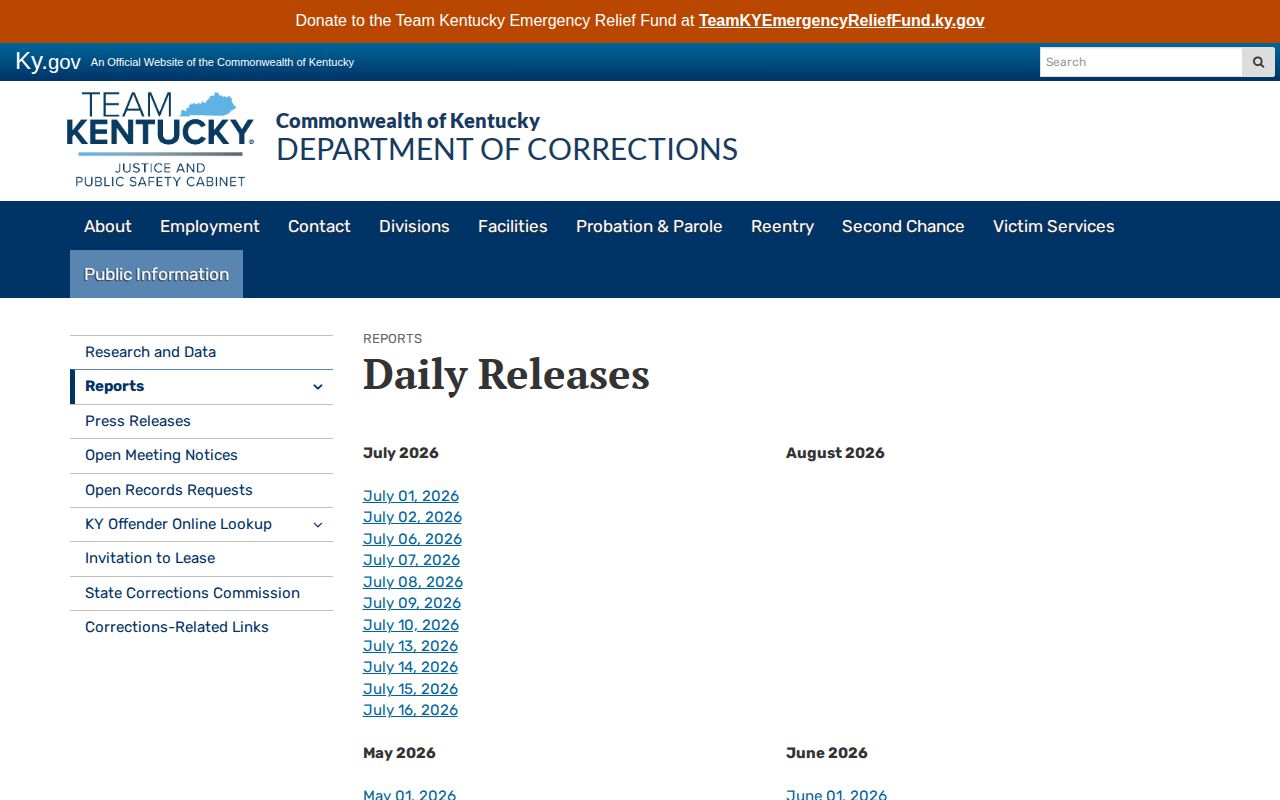
A matching PDF can confirm that the projected state date became a recorded release event and identify the release type and source facility.
Boyd Parole Eligibility Dates
Parole eligibility is a review threshold, not a promise of release. KRS 439.340 contains rules for nonviolent eligibility. One current example gives a qualifying nonviolent Class D offender with an aggregate sentence of one to five years Board review after fifteen percent or two months of the original term, whichever is longer. The offense, sentence structure, and other statutory requirements still control.
A hearing may occur before the eligibility date. The Kentucky Parole Board may grant parole subject to conditions, defer consideration, require service to sentence completion, rescind an earlier grant, or later revoke release. A calendar entry proves only that review was scheduled. The final decision and correctional status determine what happened next.
Sex-offender treatment requirements, consecutive terms, offense dates, and other laws may change the route. Do not subtract a percentage from a sentence and announce a Boyd County release date. Copy the KOOL eligibility label, read the sentence, and obtain the Board record when parole is involved.
Boyd County and State Dates
Boyd County Detention Center houses a mixed population. A pretrial detainee may leave under bond or court order without any computed state projected date. A county-sentenced person may complete a local term. A Kentucky DOC inmate housed in the same building follows the state sentence and may appear in KOOL and Daily Releases.
The local website does not publish a Boyd County good-time formula. KRS 197.045 should not be applied automatically to a pretrial stay or every county misdemeanor sentence. For a local sentence, use the judgment, credited time, and jail or clerk record. For a DOC sentence, use KOOL labels and the Department's computation.
This distinction also affects a roster disappearance. A state inmate can leave the Boyd building through transfer to another DOC placement. That is not release from Kentucky authority, and it does not confirm that a projected date arrived. Read the receiving location and state status before drawing a conclusion.
Boyd Holds Change Destinations
A detainer is a request from another authority to hold or transfer a person. It may come from another county, a state or federal matter, or immigration custody. The first sentence can reach its calculated end while the person moves directly to another authority. The original release date then describes departure from one custody source, not unrestricted release.
Federal prerelease placement also requires separate reading. A transfer from FCI Ashland to a residential reentry center remains BOP custody. A past BOP release date with no institution supports departure from BOP custody, but supervised release may continue. Kentucky KOOL does not calculate the federal term.
For a disputed destination, compare the jail movement record, KOOL location and status, BOP locator when relevant, and the court docket. The record that created the hold is the best source for its present effect. Record both the departure time and receiving authority when the documents supply them. That preserves the difference between transfer and community release.